The best chairs don't manage the behaviour of their board. They engineer the system that produces it.
Nearly every board wrestles with the same handful of problems, and it is almost never the people. It is the way the board itself is put together. See that clearly and you can change it. This book shows you how, and I would like to send you a copy, free.
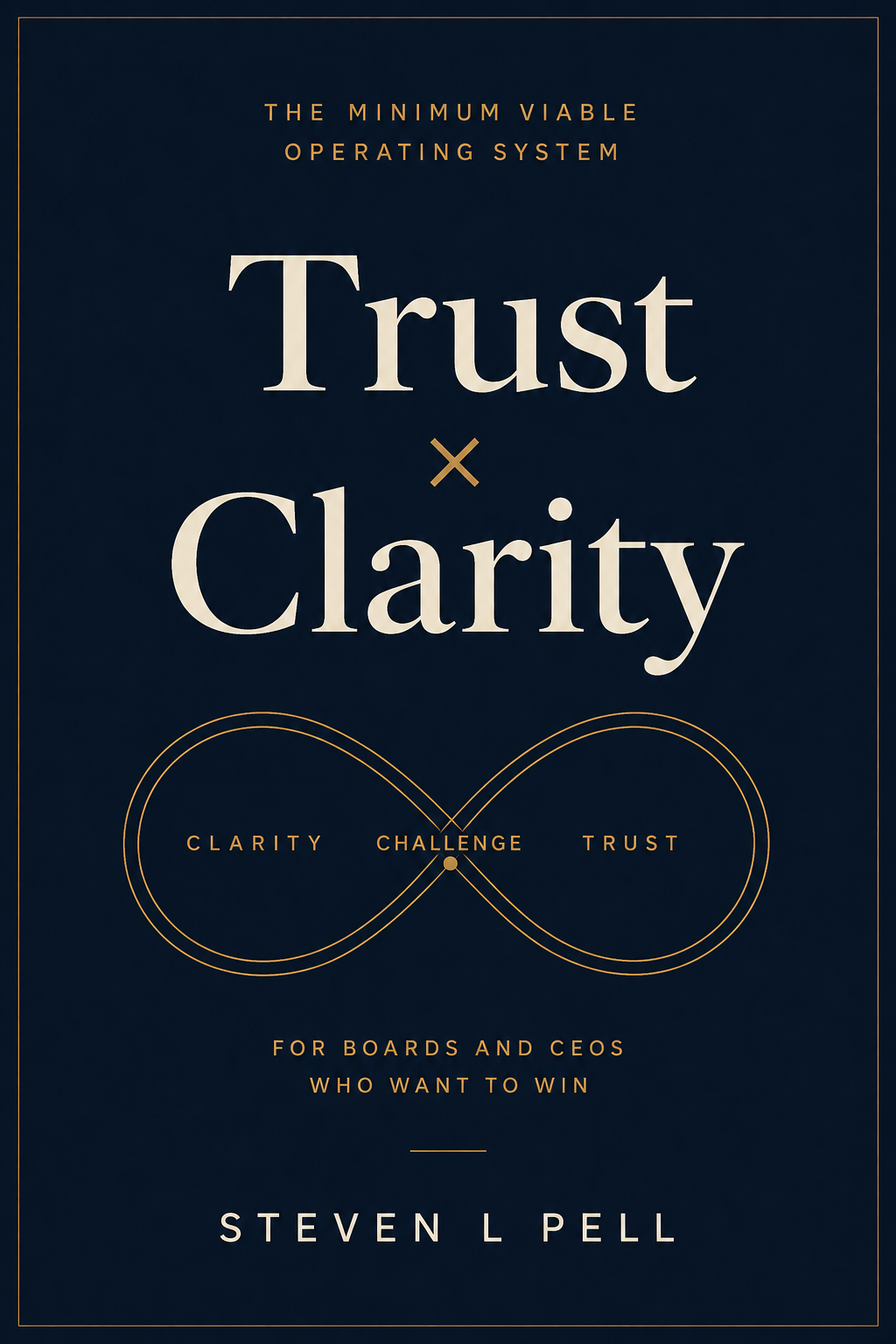
A board can be one of the organisation's biggest advantages, but most fall short.
When a board is genuinely working, it is one of the most valuable assets an organisation has: sharper decisions, braver and better-judged risks, a chief executive who is both truly challenged and truly backed. Most boards never quite reach that, and it is rarely because the people are wrong.
Changing the way a board behaves is hard.
You cannot simply ask for it. Tell a board to challenge harder, trust more and get to the point, and they will nod and mean every word. Then the next real meeting arrives, the pressure is on, and everyone slides back into the roles the room quietly rewards. What you are up against is not bad intentions or weak people. It is the pull of how the board already works.
The reason is structural, not personal.
A board is not a team and it never will be. It is a complex human system shaped by power, time, stress and information you never have enough of. In a system like that, behaviour is an output, not a lever. Push on it directly and it springs back the moment you stop. Change the conditions underneath it and the behaviour changes on its own, and stays changed.
This is where the opportunity sits.
The chairs who get the most from their boards are not the ones working hardest in the room. They have stopped performing the challenge, supplying the answers and smoothing every tension, and started building the conditions in which the board does its own best work.
Push on the behaviour directly and it springs back the moment you stop. Fix the conditions underneath it, and the behaviour changes on its own — and stays changed.
This book provides a system and framework that lets you take control.
A full book in six parts, written for the person who has to hold the whole thing together. It is not a checklist. It is a way of seeing.
What it helps you understand
- Why the behaviour you keep trying to fix is an output of the system, not the people
- How to practically build challenge, without just asking people to be more challenging
- Why your own executive instincts — having the answer, moving fast, resolving conflict — work against the board you want
- How clarity, trust and challenge compound, and why the loop may currently be spinning backwards
- Why your relationship with the chief executive sets the ceiling on everything else
- How good boards drift into irrelevance with no villain and no one to blame
What it helps you do
- Diagnose where the system is failing instead of chasing every symptom
- Decide where your attention will count and where it is wasted
- Draw out genuine challenge without dominating the room
- Tell comfortable safety from the real kind that produces performance
- Catch drift early enough to do something about it
This book comes from a decade of work in nearly 500 of the world's top boardrooms, alongside the chairs and chief executives who run them. The patterns in it are the ones that kept showing up, no matter who was in the room. You will recognise your own board on almost every page.
Reserve your free copy of Trust × Clarity
One of the first 500 free copies. Sent the day it publishes in late 2026.
There are only 500, and when they are gone, they are gone. If you would like one, reserve it now and we will hold it for you.